← Certify with Pungra · Module 9 of 19 · 8 minutes
The Pungra way of teaching
No choreography
There is no routine to learn and nothing to memorise. Participants cannot get it wrong, and nobody is being prepared for a performance.
Teach on the fly from a bank of movements
Instructors build each class from a bank of movements, choosing what comes next as the class goes. See the Moves page for the movements.
The class format
Every Pungra class follows the same six parts, in this order:
- Warm up, mobility: includes dynamic stretching.
- Warm up, pulse raiser.
- Conditioning.
- Muscular, strength endurance: can include plyometrics, resistance band movements, circuit training, mat work or similar.
- Cool down, pulse reducer.
- Cool down, static stretching.
The movements you pick on the fly fit inside these parts.
- Pick the next movement while the current one is under way.
- Repeat movements so people settle into them.
- Match the energy of the music and the room.
Name moves for what the legs do
Name every movement for what the legs are doing, such as heel, stamp, lift, kick or tap, and use the same name every time. Do not use dance step names. Step names point towards performing, and they mean participants have to learn a vocabulary before they can follow. A leg-action name is understood straight away, in any language, so your cue can be one word given early. It also makes options simple to explain: a lighter stamp, a bigger stamp, or no jump at all. For participants it keeps the focus on the legs, and keeps the class a workout.
Use the whole room
Standing on the spot is a terrible wasted opportunity. A dance-fitness class to Punjabi music should use as much of the room as possible. A skilled instructor conducts many formations:
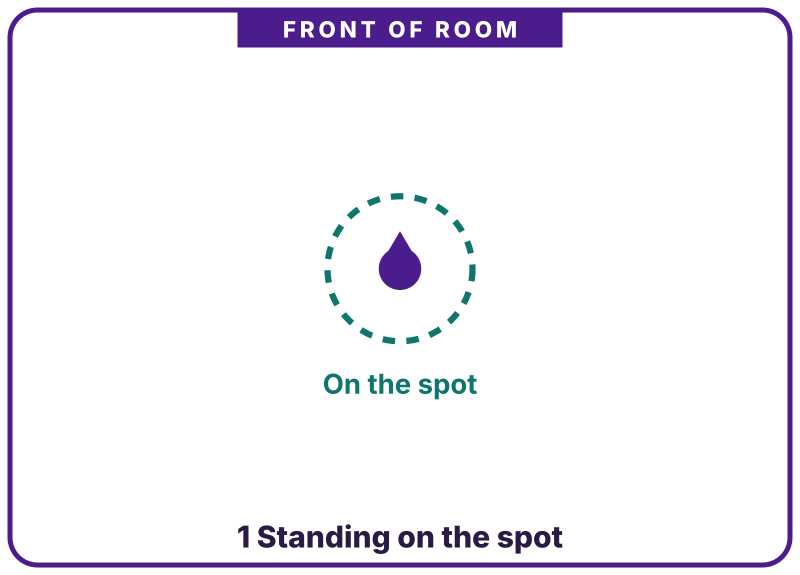
- Standing on the spot. Stay where you are.
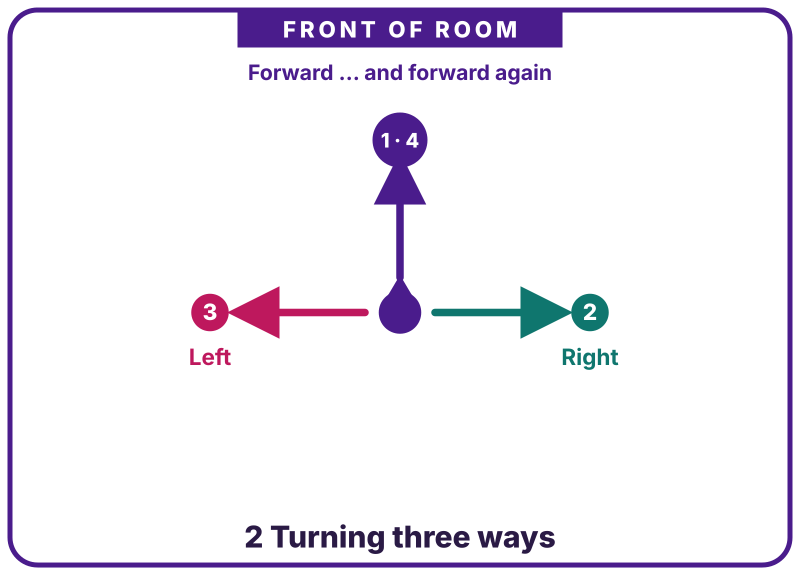
- Turning three ways. Forward, to the right, to the left, and forward again.
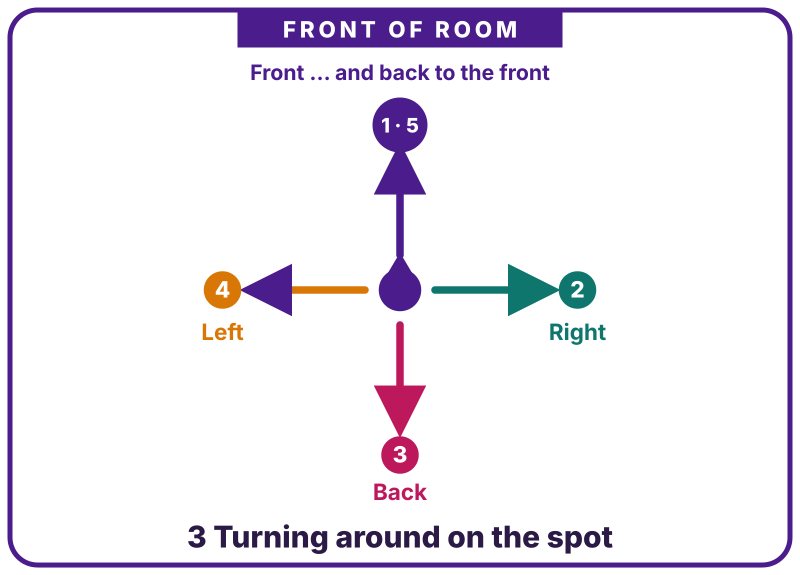
- Turning around on the spot. Forward, to the right, to the back, to the left, and back to the front.
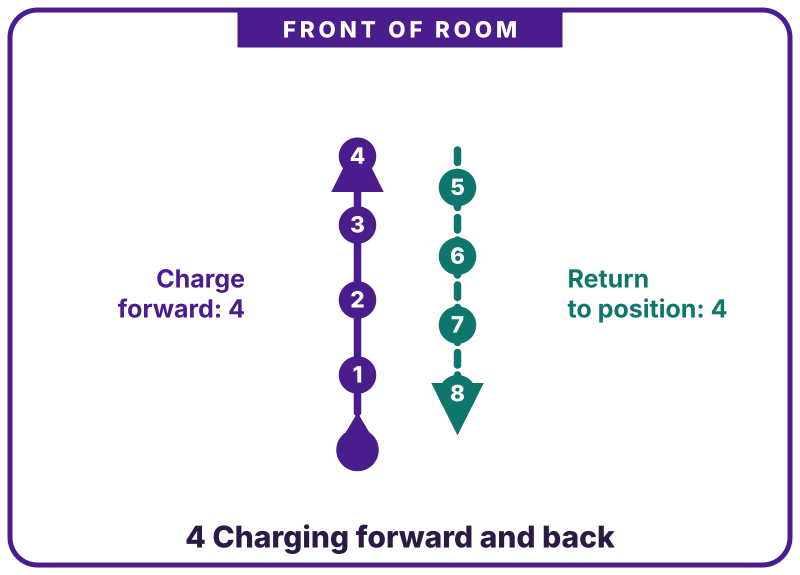
- Charging forward and back. Charge forward for a count of four, and return to position for a count of four.
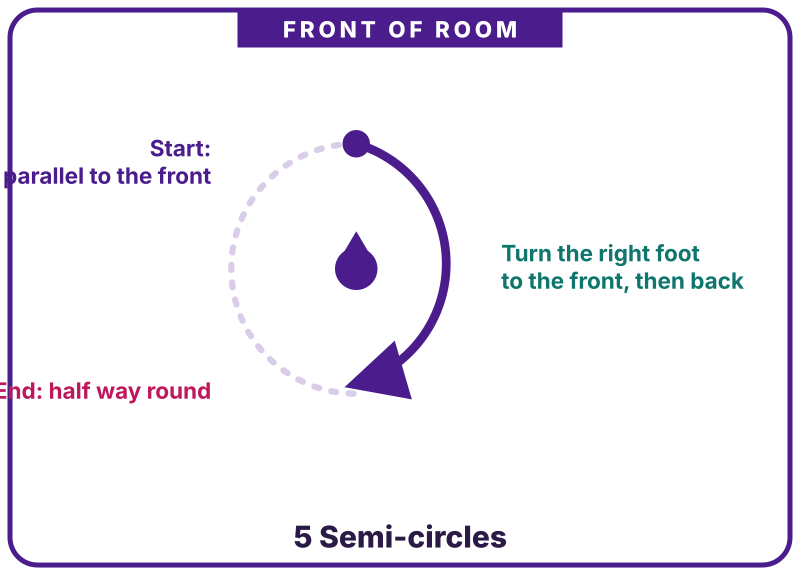
- Semi-circles. Start parallel to the front, then turn the right foot to the front and then to the back, so the whole body turns halfway.
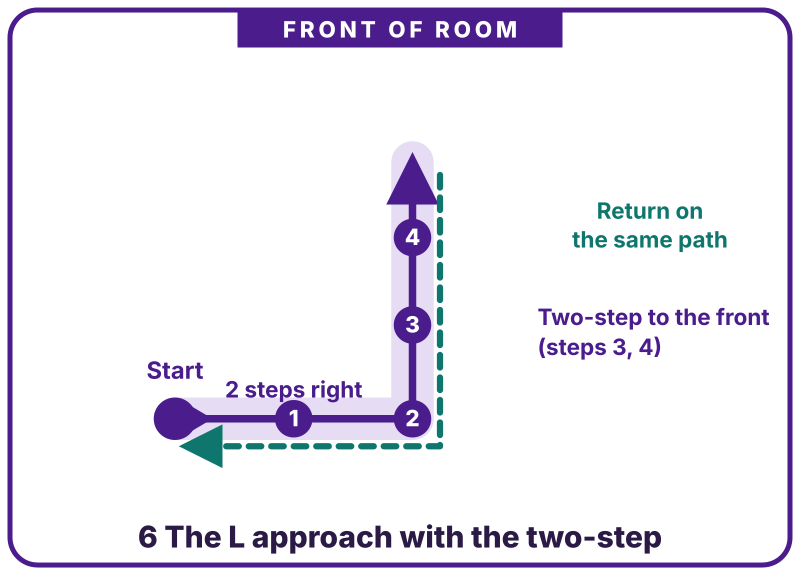
- The L approach with the two-step. Step to the right twice, then turn to do the two-step to the front, then return on the same path, forming an L shape on the floor.
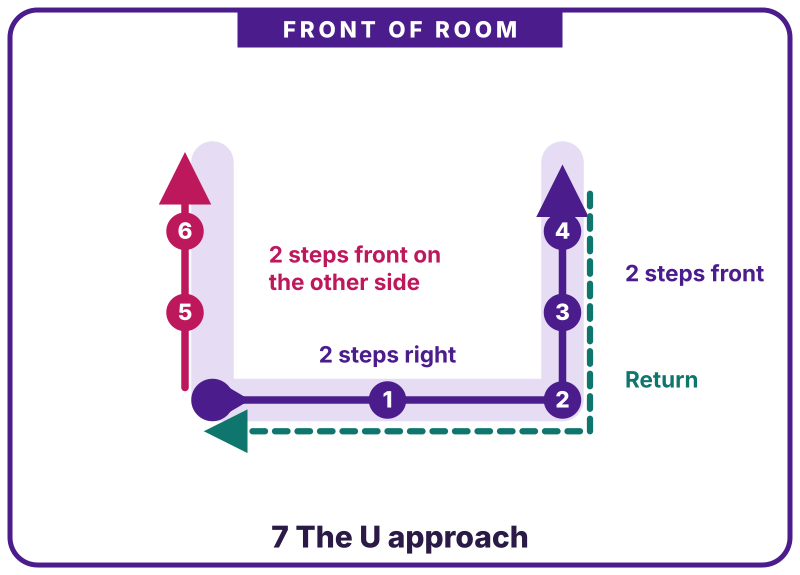
- The U approach. Two steps to the right, two steps to the front, return to the beginning, then two steps to the front on the other side, forming a U shape on the floor.
These are not a routine to memorise. Choose them on the fly, as you choose movements, and cue each one before it starts. Check the room is clear, with space between people, before you travel.
Look like exercise
Ask what a serious bodyweight exercise programme looks like, and look at resistance training, spinning, pilates and yoga. A fitness centre expects the same seriousness from dance-fitness. You set the example for your participants, so avoid the five behaviours that reduce it:
- Grinning from ear to ear. Keep a focused face, with a real smile when it comes naturally.
- Hair open and kept loose. Tie it back, away from your face.
- Heavy make-up. Keep it minimal.
- Clothing that suits the stage, not the gym. Wear what you would wear to lead any exercise class. See the fabric notes on the Join Class page.
- Quick and sudden changes in the movements. Transition smoothly, and cue before every change.
Evidence note: These standards come from the founder’s conversations with thousands of customers, fitness managers and assessors about what good and successful looks like. They are Pungra’s own view, not the result of a study.
Options for every level
Offer a lower and a higher intensity for each movement, so a first-timer and a regular can work side by side. Say the options out loud, and make it clear that choosing the easier option is normal.
Clear cues in a loud, fast class
- Name the movement before you do it, using the same name every time.
- Keep cues short, and give them early.
- Show as well as say: your demonstration is often louder than your voice.
- Keep your face towards the class, and be aware of newcomers.
Impact options: low, medium and high
Offer a choice of impact with every cue. Low impact: no jumping and no bouncing, with the arms kept at or below heart level. Medium impact: gentle bounces, heels up and down, and steps. High impact: full jumps. The lowest version works the same way in the mobility section and in the cool down: no jumping, no bouncing, and arms never above heart level. Bouncing and jumping work the calf muscles, the “second heart”, and put healthy load on the bones. Studies of jump training found a small average gain in hip bone density of about one and a half per cent, from short bursts of impact with rest in between, so you do not need a lot of jumps.
Make clear that choosing the lower option is a skill, not a failure. The gains are modest and take time, so describe them as helping to maintain strong bones, not as a cure for anything.
Sources and further reading
- Karageorghis and Priest (2012): Music in the exercise domain, a review and synthesis, Part II (International Review of Sport and Exercise Psychology): that motivational music can improve affect and lower perceived exertion during endurance exercise.
- Farrance, Tsofliou and Clark (2016): Adherence to community-based group exercise for older people (Preventive Medicine): social connectedness, instructor behaviour and programme design as themes in sticking with group exercise (limited evidence, ten studies).
- Skeletal site-specific effects of jump training on bone mineral density in adults: about +1.5% at the femoral neck.
- Bone loading review: short bursts of impact with rest between loads.
- Skeletal muscle pump (Wikipedia): the calf muscle pump and venous return, with links to the reviews.
Evidence notes: The Pungra way of teaching is Pungra's own approach: no choreography, teaching on the fly, and options at every level. Research supports music and social connection in exercise. Last checked 7 November 2026. Links open in a new tab, and some sites may ask you to accept cookies or sign in. The bone result is a small average gain from jump-training studies. We found no study of bhangra or Punjabi style movement itself.